
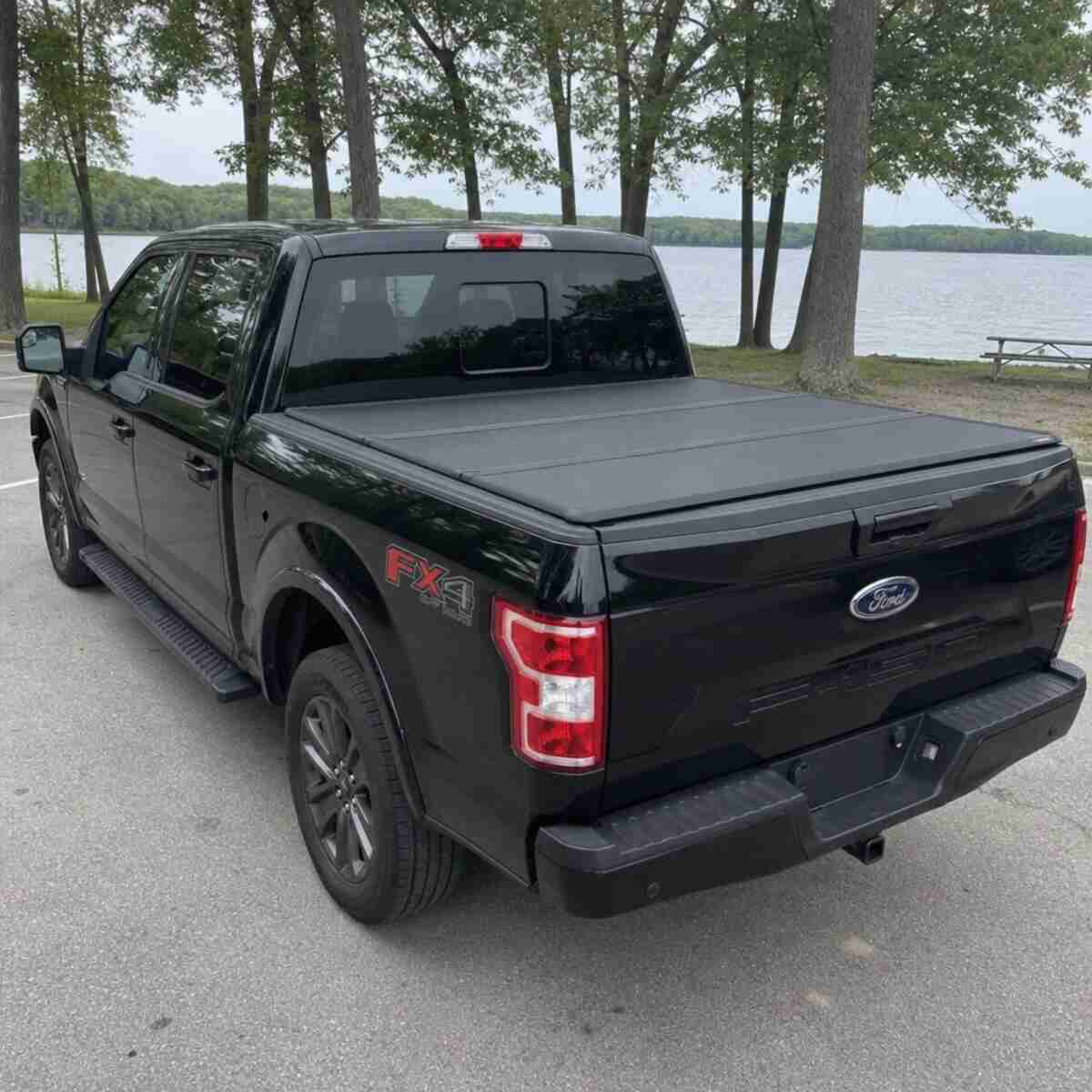

Investing in a pickup truck is a significant milestone for any driver. Whether you use your vehicle for heavy-duty hauling, weekend off-roading adventures, or simply as a daily commuter, optimizing its utility is always a top priority. Among the most popular and practical truck accessories available today is the tonneau cover. Designed to protect your cargo, improve fuel efficiency, and enhance your vehicle’s overall aesthetics, a bed cover is an indispensable addition to any truck. Choose the best tonneau cover.
However, navigating the crowded market of truck bed covers can be overwhelming. One of the most common dilemmas truck owners face is the Tri-Fold vs Flipback Quad-Fold Tonneau Cover debate. Both styles offer exceptional security and convenience, but they cater to slightly different needs regarding bed access, visibility, and ease of use.
In this comprehensive guide, we will dive deep into everything you need to know about folding bed covers. From analyzing the exact difference between three panel and four panel tonneau covers to exploring the impact of folding bed covers on truck aerodynamics, this article will equip you with the knowledge to make an informed purchasing decision.
Understanding the Basics of Folding Tonneau Covers
Before we can effectively compare specific models or delve into the nuances of materials and installation, it is crucial to understand the foundational designs of folding bed covers. Folding covers are characterized by rigid or semi-rigid panels connected by hinges, allowing the user to fold the cover back toward the truck cab to access the bed.
What is a Tri-Fold Tonneau Cover?
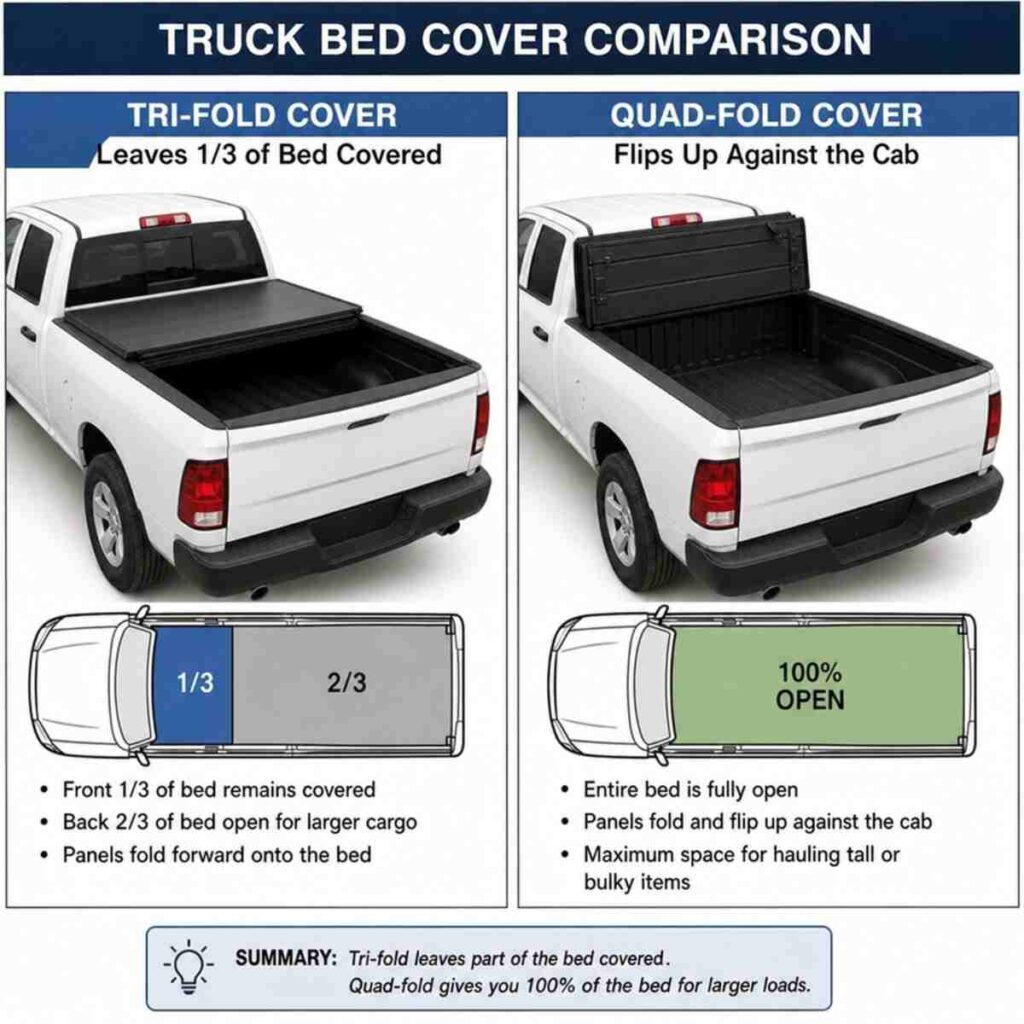
As the name suggests, a tri-fold tonneau cover consists of three distinct panels. When you need to access your truck bed, you unlatch the panel nearest the tailgate and fold it over the middle panel. You can then fold both over the final panel, the one nearest the cab. While this design is incredibly popular for its simplicity and ease of use, traditional tri-fold covers typically leave the final third of your truck bed uncovered unless you remove the entire unit.
What is a Flipback Quad-Fold Tonneau Cover?
A flipback quad-fold cover (often referred to simply as a quad-fold or a hard-folding flip-up cover) consists of four panels. The critical advantage of this design is its ability to fold all the way up against the back of the truck cab. By utilizing smaller, more numerous panels, this design transforms into one of the most efficient full truck bed access truck bed covers on the market. You get 100% access to your truck bed without needing to physically remove the cover from the bed rails.
The Great Debate: Tri-Fold vs Flipback Quad-Fold Tonneau Cover
Choosing between a standard tri-fold and a flipback quad-fold requires a careful assessment of how you use your truck on a daily basis. Let’s break down the primary factors that differentiate these two popular styles.
1. Bed Access and Cargo Space
The most significant difference between three panel and four panel tonneau covers lies in how much of your truck bed you can use when the cover is open.
- Tri-Fold: If you frequently haul smaller items—like groceries, toolboxes, or camping gear—a tri-fold is often more than sufficient. You can access 66% of your bed in seconds. However, if you suddenly need to transport a large piece of furniture or a dirt bike, that stationary third panel nearest the cab can get in the way.
- Quad-Fold: For contractors, movers, and powersports enthusiasts, the quad-fold is a game-changer. Because the panels fold completely upright against the cab, you achieve full bed access. You can load a refrigerator or a motorcycle without wasting twenty minutes unbolting your cover.
2. Rear Window Visibility: Do Quad-Fold Covers Obstruct Rear Window Visibility?
A very common and valid question buyers ask is: Do quad-fold covers obstruct rear window visibility? The short answer is yes. When a flipback quad-fold cover is fully deployed in its upright position (allowing 100% bed access), the panels rest vertically against the cab’s rear window. This completely blocks the driver’s view through the rearview mirror.
To mitigate this, drivers must rely heavily on their side mirrors and backup cameras when driving with a quad-fold cover fully open. Conversely, a standard tri-fold cover rests flat on the bed rails when secured open, leaving your rear window completely unobstructed. If rear visibility while hauling large loads is a critical safety concern for you, a standard tri-fold might be the safer bet.
3. Ease of Operation
Both styles are designed for quick, one-handed operation. However, because quad-folds consist of four smaller panels rather than three large ones, each individual panel is slightly lighter and easier to flip. On the other hand, the final step of pushing a quad-fold cover upright and securing it to the cab requires dedicated prop rods, adding a slight extra step to the opening process.
Top Tri-Fold Tonneau Covers by Category
If you have decided that a three-panel design best fits your lifestyle, the next step is to select the right model. Here are the top tri-fold cover categories dominating the market, along with the features to look for.
1. Best Overall Premium Hard Tri-Fold
For those who want maximum security and durability, a premium hard tri-fold is the way to go. These covers are typically constructed from heavy-duty aircraft-grade aluminum. They offer an ultra-sleek, flush-mount design that looks like it came straight from the factory. Look for covers that feature matte-black powder coats to resist UV fading and scratches.
2. Best Folding Covers for Short Bed Pickup Trucks
Short bed trucks (typically featuring 5.5-foot beds) present unique spatial challenges. When every inch of cargo space matters, you need a cover that doesn’t consume valuable bed real estate. The best folding covers for short bed pickup trucks are those that mount inside the bed rails rather than sitting on top of them. This low-profile design ensures that the cover doesn’t interfere with stake pocket holes, allowing you to mount ladder racks or tie-downs simultaneously.
3. Top Rated Flip Back Truck Bed Covers for Off-Roading
When you take your truck off the beaten path, your bed cover will be subjected to intense vibrations, heavy dust, and potential impacts from rocks and branches. The top rated flip back truck bed covers for off-roading feature heavy-duty shock absorbers, reinforced hinges, and exceptional weather seals. Look for models built from rugged composite materials that absorb impacts without denting, keeping your overlanding gear safe and dry.
4. Best Budget-Friendly Soft Tri-Fold
Not everyone needs a heavy-duty hard cover. If your primary goal is to keep leaves, rain, and prying eyes out of your bed without breaking the bank, a soft tri-fold cover is an excellent choice. Constructed from marine-grade vinyl stretched over an aluminum frame, these covers are incredibly lightweight and can be installed or removed by one person in under five minutes.
Material Matters: Aluminum Versus Composite Folding Cover Durability
When selecting a hard folding cover, you will inevitably have to choose between two primary materials: aluminum and composite. Understanding aluminum versus composite folding cover durability is essential for making a long-term investment.
The Case for Aluminum Covers
Aluminum is the traditional heavyweight champion of hard folding covers.
- Strength: Extruded aluminum panels offer incredible rigidity. They are virtually impenetrable to thieves armed with knives or basic hand tools.
- Weight Capacity: The weight capacity of folding truck bed panels made from aluminum is highly impressive. Many premium aluminum tri-folds can support between 300 and 400 pounds of evenly distributed weight. This means you can safely brush heavy snow off the cover, or even strap lightweight gear directly on top of it.
- Drawbacks: Aluminum is susceptible to denting. A severe hail storm or a dropped piece of firewood can leave permanent dings. Additionally, raw aluminum conducts heat, meaning the cover can become extremely hot to the touch under the summer sun.
The Case for Composite (FRP) Covers
Fiberglass Reinforced Polymer (FRP) and other high-tech composite materials are rapidly gaining popularity.
- Dent and Scratch Resistance: Unlike aluminum, composite panels are highly impact-resistant. They tend to bounce back from impacts that would leave a permanent dent in a metal cover. They also resist scratching much better than powder-coated aluminum.
- Temperature Regulation: Composites do not conduct heat the way metal does, keeping the cover cooler to the touch and providing a slightly better insulated environment for the cargo underneath.
- Weight Capacity: High-end composite covers boast a weight capacity of folding truck bed panels that can rival or even exceed aluminum—sometimes supporting up to 500 pounds of evenly distributed weight.
- Drawbacks: Composite covers can sometimes be heavier than their aluminum counterparts, making them slightly more cumbersome to completely remove from the truck.
Aesthetic and Functional Design Profiles
Truck owners are deeply passionate about the appearance of their vehicles. A tonneau cover shouldn’t just be functional; it should enhance the truck’s aggressive, sleek, or rugged aesthetic.
Low Profile Versus High Profile Folding Covers
When browsing covers, you will see them categorized by how they sit on the bed.
- Low Profile Covers: These covers are designed to sit perfectly flush with the top of the truck’s bed rails. They are mounted using a rail system clamped to the inside lip of the truck bed. The result is a seamless, aerodynamic look that many modern truck owners prefer.
- High Profile (Top-Mount) Covers: These covers sit directly on top of the truck’s bed rails, usually overlapping them by an inch or two. While they don’t look as sleek as low-profile covers, they offer a distinct advantage: they maximize the vertical cargo space inside the bed. Furthermore, because they sit on top of the rails, their weather seals are often compressed downward by gravity, which can sometimes result in superior water resistance.
The Impact of Folding Bed Covers on Truck Aerodynamics
It is a long-standing debate in the truck community: Does a tonneau cover actually improve gas mileage? The science behind the impact of folding bed covers on truck aerodynamics is fascinating.
When you drive an open-bed pickup truck at highway speeds, air flows over the cab and dips down into the truck bed, slamming against the closed tailgate. This creates a pocket of high pressure and significant aerodynamic drag, which forces your engine to work harder and burn more fuel.
By installing a tonneau cover—whether it is a tri-fold or a quad-fold—you smooth out the vehicle’s aerodynamic profile. The air flows seamlessly off the cab roof, glides across the flat tonneau cover, and rolls off the tailgate. While the fuel savings won’t pay for the cover overnight, wind tunnel tests have consistently shown a reduction in aerodynamic drag by up to 10%, which can translate to an improvement of 1 to 2 miles per gallon on the highway.
Security: Securing Cargo with Locking Tonneau Cover Mechanisms
One of the primary reasons truck owners invest in hard folding covers is security. An open truck bed is an open invitation to thieves. However, not all locking mechanisms are created equal.
The Synergy of Tailgate Locks
Most modern hard folding tonneau covers do not have external keyholes. Instead, they feature latches beneath the panels that are accessible only when the tailgate is open. This is a brilliant design feature. By securing cargo with locking tonneau cover mechanisms that are hidden beneath the panels, you turn your truck bed into a massive vault. As long as you lock your truck’s tailgate (which is standard on almost all modern trucks), the tonneau cover cannot be opened.
Automatic Latching Systems for Multi-Fold Covers
Older tonneau covers required the user to manually slide a locking pin into the bed rails on both the driver and passenger sides of every panel. This was tedious and time-consuming.
Today’s premium models feature automatic latching systems for multi-fold covers. These systems utilize rotary latches or slam-latches. As you fold the panel down, the latch automatically snaps into the track on the bed rail, securing itself without any extra effort on your part. To open the cover, you simply pull a centralized release cable located near the tailgate, which simultaneously disengages the latches on both sides of the bed.
Weather Protection Ratings for Folding Bed Covers
No folding tonneau cover is 100% waterproof. Because these covers have hinges, seams, and tailgate gaps to contend with, heavy rain or pressurized car washes will almost inevitably result in a few drops of water finding their way into the bed. However, a high-quality cover will keep your cargo overwhelmingly dry.
When looking at weather protection ratings for folding bed covers, pay attention to the sealing technology. The best covers utilize:
- EPDM Rubber Seals: EPDM (Ethylene Propylene Diene Monomer) is an incredibly durable synthetic rubber that resists UV degradation, extreme cold, and intense heat without cracking or shrinking. Covers with perimeter EPDM seals offer superior water resistance.
- Integrated Water Drainage Systems: Low-profile, flush-mount covers route water into the aluminum mounting rails. These rails act as gutters, catching any water that slips past the hinges. The water is then funneled through drainage tubes that are routed out through factory holes in the truck bed, keeping the main cargo area dry.
- Overlapping Hinges: Instead of exposed rubber hinges, premium hard covers use interlocking aluminum or composite hinges that channel water away from the seams, actively preventing pooling and leaking.
Hard Folding Tonneau Cover Installation Guide
Many truck owners hesitate to buy a hard folding cover because they fear the installation will require professional help or permanent modification to their vehicle. Fortunately, almost all modern folding covers feature a no-drill clamp-on installation.
Here is a comprehensive hard folding tonneau cover installation guide to help you get your cover set up perfectly in under an hour.
Tools You Will Need:
- A 9/16″ or 1/2″ wrench or socket set (size depends on the cover brand)
- A Phillips head screwdriver
- A tape measure
- Spring clamps (optional, but helpful for holding rails in place)
- Rubbing alcohol and a clean microfiber cloth
Step 1: Pre-Installation Prep
Start by thoroughly cleaning the top of your truck’s bed rails and the bulkhead (the wall of the bed closest to the cab) using rubbing alcohol. This ensures that any weather stripping you apply will adhere properly. If your cover comes with a separate bulkhead weather seal, apply it perfectly straight across the bulkhead now.
Step 2: Position the Mounting Rails (For Flush-Mount Covers)
If you have a low-profile cover, it will come with two side mounting rails. Place the driver-side rail against the inside lip of the truck bed. Ensure it is pushed all the way forward against the bulkhead and sits level.
Step 3: Install the Clamps
Most rails require three clamps per side.
- Place the first clamp as close to the bulkhead as possible.
- Place the second clamp perfectly centered over the wheel well.
- Place the third clamp as close to the tailgate as possible. Pro-Tip: Hand-tighten the clamps first. Before using your wrench, apply downward pressure on the rail to ensure it sits perfectly flush with the truck’s bed cap. Tighten the clamps until the lock washers flatten out, but do not overtighten, as this can bend the aluminum rail. Repeat this process on the passenger side.
Step 4: Position the Tonneau Cover
Carefully lift the folded tonneau cover assembly onto the truck bed. Place it near the cab. Most covers will have elevator bolts that drop down through the front panel and into brackets located on the mounting rails.
Step 5: Align and Tighten
Before tightening the front panel, unfold the cover completely toward the tailgate. Check the alignment. The cover should be perfectly centered side-to-side, and the rear rubber seal should rest evenly on top of the closed tailgate. Once you are satisfied with the alignment, carefully fold the cover back up to the cab and tighten the front elevator bolts fully.
Step 6: Route the Drainage Tubes
If your cover utilizes a rail gutter system, locate the drainage tubes. Attach them to the spouts at the front of the mounting rails, and route the other end through the factory drain plugs located in your truck bed’s bulkhead.
The Quick Release Tonneau Cover Removal Process
There will be times when you need 100% of your bed completely free of obstructions. The quick release tonneau cover removal process makes this incredibly simple. For most premium covers, you simply fold the cover all the way up to the cab. Underneath the front panel, you will find two quick-release knobs or pull-pins. Unscrew or pull these, and the entire 50-pound cover can be lifted off the truck by one person in less than 60 seconds. The mounting rails stay attached to the truck, meaning re-installation will take mere seconds and won’t require any re-alignment.
Maintenance and Longevity: Protecting Your Investment
A high-quality tonneau cover is an investment that can easily exceed $1,000. To ensure it lasts as long as your truck, routine maintenance is essential.
How to Maintain Tonneau Cover Hinges and Seals
The hinges and perimeter seals are the most vulnerable parts of any folding cover. Over time, UV exposure, freezing temperatures, and road debris can cause wear and tear.
- Cleaning the Seals: Every time you wash your truck, use a damp microfiber cloth to wipe down the rubber seals along the cover’s edges and hinges. This removes dirt and microscopic grit that can act like sandpaper over time, degrading the seal’s water-resistant properties.
- Conditioning the Rubber: Every three to four months, apply a high-quality, water-based UV protectant to all the rubber seals. Do not use silicone-based or petroleum-based products. Petroleum will cause the EPDM rubber to swell, crack, and dry out prematurely. A proper water-based vinyl/rubber protectant will keep the seals supple, black, and highly effective at repelling water.
- Lubricating the Hinges: For aluminum covers with continuous hinges, a quick spray of dry graphite lubricant or a Teflon-based spray twice a year will keep the folding mechanism smooth and prevent binding. Avoid greasy lubricants like standard WD-40, as they will attract and hold dust and dirt.
Cleaning the Panels
Whether you have an aluminum or composite cover, avoid driving through automatic car washes that use harsh rotating bristle brushes, as these can leave micro-scratches on the matte finish. Wash the cover by hand using standard automotive car wash soap and a soft mitt. For stubborn bird droppings or tree sap, let a soapy sponge sit on the affected area for a few minutes to soften the debris before wiping it away.
Clearing the Drainage System
If you frequently park under trees, pine needles and leaves can find their way into the side mounting rails. Over time, this debris will wash forward and clog the drainage tubes. If the tubes are clogged, water will overflow the rail gutters and spill into your truck bed. Make it a habit to check the rails during your routine car wash. If the drainage tubes are clogged, simply pull them out, flush them with a garden hose, and reattach them.
Actionable Tips for Choosing the Right Cover for Your Truck
With so much information to digest regarding the Tri-Fold vs Flipback Quad-Fold Tonneau Cover debate, here is a quick checklist of actionable tips to guide your final decision:
- Assess Your Hauling Frequency: If you move large furniture, ATVs, or tall appliances regularly, prioritize a quad-fold cover for its full-bed access. If your bed is primarily used for tools, luggage, or groceries, a standard tri-fold is more than adequate.
- Consider Your Climate: If you live in an area prone to massive snow accumulation or frequent hail storms, heavily prioritize covers made from impact-resistant composite materials or heavy-gauge aluminum capable of supporting high weight capacities.
- Check Your Bed Accessories: Do you have a drop-in plastic bed liner? You may need to trim the liner near the cab to allow the flush-mount clamps to grip the truck’s sheet metal. Ensure your chosen cover is compatible with your current bed liner setup.
- Factor in Security Needs: If you keep expensive tools in your bed, avoid soft-vinyl folding covers. A pocket knife is all it takes to bypass them. Invest in an aluminum or composite cover featuring automatic slam latches that pair seamlessly with your locking tailgate.
Conclusion
Choosing the perfect truck bed cover is one of the most rewarding modifications you can make to your vehicle. It enhances your truck’s functionality, protects your valuable cargo from thieves and the elements, and gives your pickup a refined, finished appearance.
The decision between a Tri-Fold vs Flipback Quad-Fold Tonneau Cover ultimately comes down to your personal lifestyle and how you utilize your truck’s cargo space. A traditional tri-fold offers simplicity, unobstructed rear-window visibility, and fantastic ease of use for everyday tasks. Meanwhile, the modern flipback quad-fold stands out as the ultimate solution for those who demand total versatility, granting full bed access at a moment’s notice.
By understanding the vital difference between three panel and four panel tonneau covers, familiarizing yourself with aluminum versus composite folding cover durability, and taking the time to properly maintain your investment, you will enjoy years of secure, weather-resistant, and aerodynamically efficient hauling.
Equip your truck with the right folding cover today, and experience the peace of mind that comes with knowing your gear is safe, secure, and ready for whatever the road throws your way.
