


The electrical industry is currently experiencing a massive boom, driven by infrastructure upgrades, the rise of smart home technologies, the adoption of electric vehicles, and a general surge in residential and commercial construction. However, with this unprecedented growth comes a significant bottleneck: a severe shortage of skilled labor. For master electricians, journeymen, and electrical contracting business owners, the inability to find reliable support staff is capping revenue potential and leading to severe burnout. Best way to find the electrician near me.
This is exactly where the strategic implementation of electrician helper hiring comes into play. By bringing on dedicated, hardworking helpers to take over the repetitive, physically demanding, and lower-skill tasks, you free up your highly paid licensed electricians to do what they do best: complex wiring, panel upgrades, and critical problem-solving.
This comprehensive guide will walk you through every single phase of the hiring process. From drafting the perfect job description to vetting, interviewing, onboarding, and retaining your new team members, we will cover the strategies you need to build a robust, highly productive workforce.
The Strategic Value of Hiring an Electrician Helper
Before diving into the mechanics of recruiting, it is crucial to understand the “why.” Many independent contractors hesitate to hire helpers because they fear the time investment required for training. However, the return on investment (ROI) is substantial when executed correctly.
1. Maximizing Journeyman Efficiency
A licensed journeyman earns a premium wage. If your journeyman spends two hours a day loading and unloading the truck, sweeping the job site, organizing materials, and pulling simple wire runs, you are losing money. By increasing job site productivity with laborers and helpers, your top-tier talent can focus exclusively on revenue-generating, high-skill tasks.
2. Building a Talent Pipeline
The trades are aging. The average age of an electrician in the United States is hovering in the early 40s, with a massive wave of retirements looming. When you focus on electrician helper hiring, you are not just filling a temporary labor gap; you are auditioning future journeymen and master electricians for your company.
3. Improving Customer Satisfaction
Having an extra set of hands means jobs get done faster. It also means the job site stays cleaner, as the helper can actively manage debris and tool organization while the primary electrician works. In residential settings, a clean, swift job directly translates to five-star reviews and customer referrals.
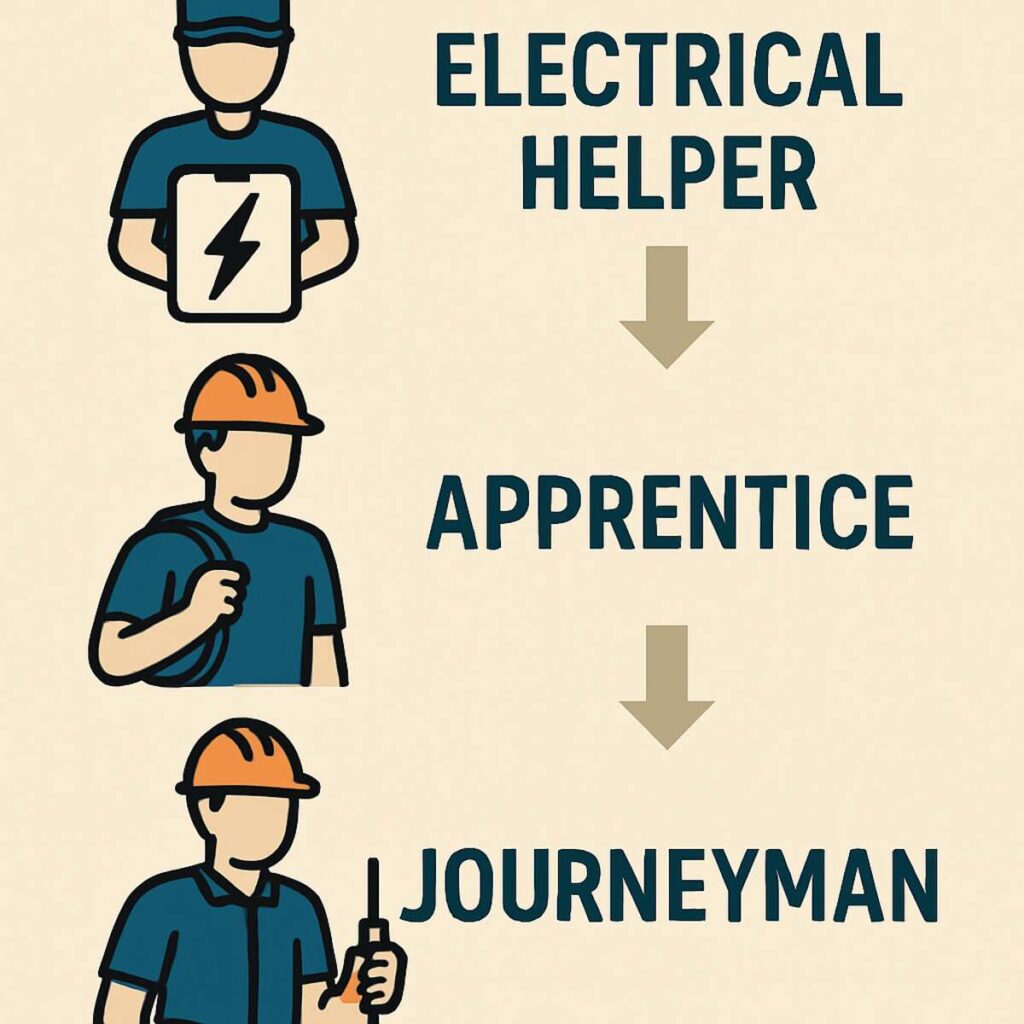
Apprentice vs Helper Roles Explained
One of the most common points of confusion in the electrical trade is the distinction between a “helper” and an “apprentice.” While the terms are sometimes used interchangeably in casual conversation, they have very different legal, financial, and professional implications. Understanding this difference is step one in defining your electrician job openings.
The Electrician Helper
An electrician helper is essentially an entry-level laborer specific to the electrical trade.
- Primary Duties: Their main job is to support the licensed electrician. This includes carrying tools, driving the company vehicle, organizing the shop, keeping the job site clean, digging trenches for underground conduits, and retrieving materials.
- Commitment Level: Helpers are usually not enrolled in a formal educational program. This role is often seen as a trial period. It gives the individual a taste of the trade to see if they want to pursue it long-term.
- Regulatory Status: In most states, helpers are not registered with the state apprenticeship board, meaning their hours do not count toward the thousands of hours required to sit for a journeyman exam.
The Electrical Apprentice
An apprentice is an employee who has committed to learning the trade formally.
- Primary Duties: While they will still sweep floors and carry tools, an apprentice is actively being taught how to perform electrical work under the direct supervision of a journeyman. They are learning code, reading blueprints, and wiring circuits.
- Commitment Level: Apprentices are usually enrolled in a multi-year program (often 4-5 years) that includes both classroom instruction and on-the-job training (OJT).
- Regulatory Status: Apprentices are registered with the state or a recognized trade organization (like the IEC or JATC). Their work hours are meticulously logged and reported so they can eventually test for their license.
The Takeaway for Employers: If you just need someone to dig trenches and carry heavy spools of wire, advertise for a helper. If you want to mold someone into a future journeyman for your company, advertise for an apprentice. Often, the best strategy is to hire a helper for a 90-day probationary period, and if they prove their worth, sponsor them to become an apprentice.
Crafting the Perfect Job Description
To attract high-quality candidates, you must write a compelling job description. Generic postings yield generic, often unqualified, applicants. If you want to stand out among all the other electrical technician jobs on local job boards, your posting needs to be clear, transparent, and engaging.
Below is an electrical apprentice job description template (which can easily be adapted for a helper role) that you can copy, modify, and use for your own business.
Electrical Apprentice Job Description Template
Job Title: Electrician Helper / First-Year Apprentice Company: [Your Company Name] Location: [City, State] Job Type: Full-Time Pay Rate: [Insert Hourly Rate – e.g., $18.00 – $22.00/hour depending on experience]
About Us: At [Your Company Name], we don’t just pull wire; we build careers. We are a family-owned electrical contracting business specializing in [residential service calls / commercial build-outs / industrial automation]. We pride ourselves on top-tier craftsmanship, a strong safety culture, and treating our team like family. We are currently looking for a highly motivated, hardworking Electrician Helper to join our growing team.
The Role: Are you looking to break into the electrical trades? As an Electrician Helper at [Your Company Name], you will be the right hand to our experienced Journeymen. You don’t need to know the National Electrical Code inside and out yet, but you do need to have a strong work ethic, a willingness to learn, and the physical stamina to work in various environments. For the right candidate, this role will transition into a formal, sponsored apprenticeship.
Key Responsibilities:
- Assist Journeyman electricians in installing, repairing, and maintaining electrical systems.
- Load and unload equipment, tools, and heavy materials (up to 50 lbs) safely.
- Organize and maintain company work vans, ensuring all necessary materials are stocked for the day.
- Perform basic site preparation, including digging trenches for underground wiring and pulling wire through conduits.
- Maintain a clean and safe work environment by clearing debris and hazards from the job site.
- Learn and properly use basic hand and power tools under direct supervision.
- Adhere strictly to all company safety protocols and OSHA regulations.
What We Are Looking For (Requirements):
- Experience: No prior electrical experience is required, but experience in general construction, landscaping, or manual labor is highly preferred.
- Education: High school diploma or equivalent.
- Attitude: Punctual, reliable, and eager to learn. A positive attitude is non-negotiable.
- Physical Ability: Ability to stand for long periods, climb ladders, crawl into tight spaces (attics/crawlspaces), and lift heavy objects.
- Requirements: A valid driver’s license with a clean driving record and reliable transportation to our shop/job sites.
- Tools: Must possess (or be willing to acquire within the first 30 days) basic hand tools (tool belt, linesman pliers, tape measure, screwdrivers).
What We Offer (Benefits):
- Competitive weekly pay with opportunities for overtime.
- Clear career advancement: 90-day review with the potential for apprenticeship sponsorship.
- Health, Dental, and Vision insurance (after 60 days).
- Paid Time Off (PTO) and paid holidays.
- On-the-job training and mentorship from master electricians.
How to Apply: [Insert instructions: e.g., “Send your resume and a brief paragraph about why you want to learn the electrical trade to [email protected], or call our office at 555-0199.”]
Sourcing Candidates: Where to Find the Best Helpers
Posting on major job boards like Indeed, ZipRecruiter, and Craigslist is a standard practice, but relying on them exclusively is a mistake. The algorithms can bury your post, and you will often be flooded with unqualified applicants clicking “easy apply” without reading the requirements.
To master electrician helper hiring, you must diversify your sourcing strategies.
1. Vocational School Recruitment Strategies
Partnering with local trade schools, community colleges, and vocational high schools is arguably the highest-ROI recruiting strategy for the trades. These institutions are filled with young, eager individuals who have already demonstrated an interest in the field.
- Guest Speaking: Offer to come into an electrical trades class and speak about the realities of working in the field. Bring pizza, hand out company merch (hats, pens), and leave a stack of business cards.
- Job Fairs: Set up a booth at local high school and community college career fairs.
- Instructor Relationships: Take the lead instructors out for coffee or lunch. If a trade school instructor knows you run a fair, safe, and educational job site, they will funnel their top-performing students directly to you before they even graduate.
2. Supply House Networking
Your local electrical supply houses (like Graybar, City Electric Supply, or CED) are community hubs.
- Pin a physical flyer on their community bulletin board.
- Talk to the counter staff. Supply house employees talk to hundreds of tradespeople a week. They know who just got laid off, who is looking for a change, and which young guys are hustling hard. Let them know you have electrician job openings.
3. Transitioning Military Veterans
Veterans often make incredible construction helpers and apprentices. They are accustomed to strict schedules, chain of command, physical labor, and safety protocols. Look into programs like “Helmets to Hardhats” or local VA career centers to connect with veterans seeking electrical technician jobs.
4. Employee Referral Programs
Your current employees know exactly what it takes to succeed at your company. Implement a bounty program. For example, offer a $500 bonus to any current employee who refers a helper, payable after the new hire completes 90 days of employment.
Vetting and Screening: Separating the Wheat from the Chaff
When vetting entry level construction workers, you are not assessing their knowledge of Ohm’s law or how to wire a three-way switch. You are assessing their character, reliability, and physical aptitude. A bad hire in the trades doesn’t just cost money; it creates safety hazards.
The Initial Phone Screen
Do not skip the phone screen. A 10-minute phone call saves you an hour-long wasted in-person interview. During the phone screen, look for the following red and green flags:
- Punctuality: Did they answer the phone at the scheduled time?
- Communication: Are they clear, respectful, and articulate?
- Logistics Check: Confirm they have a valid driver’s license, reliable transportation, and understand the physical demands of the job (e.g., “Are you comfortable working in a 110-degree attic or crawling under a house?”).
Background Checks for Field Service Employees
Because your team will be entering clients’ private homes and commercial spaces, trust is paramount. Conducting background checks for field service employees is not just good business practice; it is a liability requirement.
- Criminal Background: Look for red flags related to theft, violence, or property damage. Be sure to follow all local and federal Equal Employment Opportunity Commission (EEOC) guidelines regarding hiring individuals with criminal records.
- Motor Vehicle Report (MVR): If the helper will ever be tasked with driving the company van to pick up parts, a clean driving record is vital for your commercial auto insurance policy.
- Drug Screening: Depending on your state laws and the type of work you do (especially federal or union-affiliated commercial jobs), pre-employment drug screening is standard practice in the trades.
The In-Person Interview
When the candidate arrives for the interview, the assessment begins the moment they pull into the parking lot.
- Are they on time? (Ideally, 10 minutes early).
- Are they dressed appropriately? (Clean jeans, work boots, tucked-in shirt—not a three-piece suit, but not pajama pants either).
- Did they bring a physical copy of their resume?
Interview Questions for Aspiring Electricians
To gauge a candidate’s true potential, you need to ask questions that reveal their work ethic, problem-solving skills, and attitude toward authority and safety. Here are some of the most effective interview questions for aspiring electricians and helpers, along with what to look for in their answers.
1. “Tell me about the most physically demanding job you’ve ever had.”
- Why ask this: You need to know if they can handle carrying bundles of conduit or digging a 50-foot trench.
- What to look for: Look for specific examples. You want someone who speaks proudly of hard work, not someone who complains about how tired they were.
2. “You are on a job site, and the journeyman asks you to do something you feel is unsafe. How do you handle the situation?”
- Why ask this: Safety is paramount. You want to assess their confidence in speaking up versus blind obedience.
- What to look for: The ideal answer involves pausing, respectfully questioning the journeyman, and refusing to do the task if it genuinely violates safety protocols. They should also mention bringing it to the attention of the master electrician or safety manager.
3. “Where do you see yourself in five years?”
- Why ask this: You are checking for ambition.
- What to look for: You want to hear, “I want to have my journeyman’s license and be running my own truck.” If they just want a paycheck for the summer, they might not be worth the training investment.
4. “Can you describe a time when you made a mistake at work and how you fixed it?”
- Why ask this: Electricians make mistakes; it happens. The key is accountability.
- What to look for: Candidates who own their mistakes without blaming others. You want someone who says, “I messed up, I told my boss immediately, and I stayed late to fix it.”
5. “If a customer comes up to you on a job site and starts complaining about the mess or the noise, what do you do?”
- Why ask this: Helpers are often the face of your company to the homeowner.
- What to look for: De-escalation skills. The right answer is to apologize politely, assure the customer their concerns are valid, and immediately go get the lead journeyman to handle the conversation.
Basic Hand Tool Proficiency Assessment
Do not rely solely on verbal answers. Incorporate a basic hand tool proficiency assessment into your interview process. Take the candidate out to the shop or warehouse.
- Hand them a tape measure and ask them to mark a piece of PVC pipe at 14 and 5/8 inches.
- Ask them to identify basic tools on a table (e.g., Phillips vs. flathead, linesman pliers vs. needle nose, wire strippers, channel locks).
- Hand them a battery-powered drill and ask them to drive a few screws into a 2×4.
- Note: It is okay if they don’t know the exact name of every tool, but you want to see how comfortable and natural their hands are when holding tools. Mechanical aptitude is hard to teach; they either have a natural feel for it, or they don’t.
Compensation Strategies: How Much to Pay an Electrical Assistant
One of the most frequent questions contractors ask is, “How much to pay an electrical assistant?” The answer is highly dependent on your geographic location, the type of work you do, and the current labor market. However, there are universal rules to ensure you are competitive without destroying your profit margins.
Understanding the Local Market
To attract reliable help, you cannot pay minimum wage. Construction work is hard, dirty, and dangerous. If a candidate can make $18 an hour flipping burgers in an air-conditioned room, why would they crawl under a house surrounded by spiders for $15 an hour? You must pay a premium for physical labor.
Apprentice Wage Scales by State
If you intend to transition your helper into an apprentice role, it is helpful to look at standard apprentice wage scales by state. Most formal apprenticeship programs operate on a percentage of the prevailing journeyman wage.
- First-Year Apprentice / Helper: Typically 40% to 50% of the journeyman rate.
- Second-Year Apprentice: 50% to 60%.
- Third-Year Apprentice: 60% to 70%.
- Fourth-Year Apprentice: 70% to 80%.
Example: If the going rate for a licensed journeyman in your city is $40 per hour, an entry-level helper should realistically start between $16 and $20 per hour.
- In high-cost-of-living areas (like California, New York, or urban Washington), starting wages for helpers often hover between $20 and $25 per hour.
- In lower-cost-of-living areas (like parts of Texas, Florida, or the Midwest), starting wages might range from $15 to $18 per hour.
Structuring Pay and Incentives
To keep motivation high, structure your compensation to reward reliability and skill acquisition.
- The 90-Day Bump: Start the helper at a fair base rate (e.g., $18/hr). Promise them in writing that if they are on time every day, maintain a good attitude, and pass a basic skills test at the 90-day mark, they will receive an automatic raise to $19 or $20/hr.
- Tool Allowance: Good tools are expensive, and entry-level workers rarely have the cash to buy Kleins or a good impact driver. Offer a tool allowance (e.g., $50 a month) or implement a tool-purchasing program where the company buys the tool and deducts a small amount from their paycheck weekly until it’s paid off.
- Overtime and Bonuses: Make it clear how overtime works. Consider offering small bonuses for jobs that are completed under budget or ahead of schedule to incentivize efficiency.
The Critical First Month: Onboarding and Safety
The highest rate of turnover in the trades occurs within the first 30 days. Helpers quit because they feel overwhelmed, unsupported, or unsafe. A structured onboarding checklist for electrical contractors is your best defense against early turnover.
Pre-Day One Preparations
Before the new hire even steps foot on the job site, ensure the following are completed:
- All I-9 and W-4 tax forms are filled out.
- Direct deposit information is collected.
- They have been issued any company gear (high-visibility shirts, hard hats, safety glasses, gloves).
- You have verified your workers compensation insurance for trainees. Do not let an uninsured helper lift a single box. If they injure their back on day one and your insurance is not in order, your business could face catastrophic financial liabilities.
Day One: Setting the Tone
Do not throw a new helper to the wolves on day one.
- Morning Briefing: Introduce them to the team. Explain the chain of command (e.g., “Bob is your Journeyman. Whatever Bob says, goes. If you have an HR issue, come to me.”).
- Shop Tour: Show them where tools are kept, how the vans are organized, and where the materials are.
- Safety First: Conduct a mandatory safety briefing. Show them how to properly lift heavy objects, explain the dangers of arc flashes, and point out first aid kits and fire extinguishers.
Week One Onboarding Checklist
During the first week, focus on observation and basic tasks.
- [ ] Review the company handbook and attendance policies.
- [ ] Teach them how to properly load and strap down materials in the work van.
- [ ] Instruct them on job site cleanup protocols (where to sweep, how to separate scrap copper from trash).
- [ ] Teach them how to identify different gauges of wire (14 AWG, 12 AWG, 10 AWG) and different types of cable (Romex, MC, UF).
- [ ] Practice fetching tools by name to build their vocabulary.
Week Two to Four Checklist
By week two, they should be getting their hands dirty under strict supervision.
- [ ] Teach basic wire pulling techniques without damaging the jacket.
- [ ] Instruct on how to properly mount device boxes.
- [ ] Teach the safe use of power tools (drills, bandsaws, knockout punches).
- [ ] Introduce them to basic material staging (reading a material list and gathering it from the supply house or shop).
Prioritizing Safety Certifications
Do not assume common sense is common. Electricity is deadly, and construction sites are dangerous. One of the best investments you can make is mandating an OSHA safety certification for new hires.
- OSHA 10 Construction: Require all new helpers to complete the OSHA 10-hour construction safety course within their first 30 days. You can have them do this online during slow days at the shop. The company should pay for the course and pay them their hourly wage while taking it. This not only protects the employee but significantly lowers your liability and sometimes even your insurance premiums.
Retention Strategies: How to Keep Your Best Helpers
Once you have gone through the immense effort of electrician helper hiring, vetting, and training, the last thing you want is for them to leave for a competitor over a one-dollar-an-hour raise. Reducing turnover in trade businesses requires proactive management, building a strong company culture, and laying out a clear career path.
1. Mentoring Programs for Skilled Trades
Helpers are much more likely to stay with a company if they feel someone is actively invested in their future. Pair every new helper with a designated mentor—ideally a patient, experienced journeyman who enjoys teaching.
- Avoid the “Yellers”: Not every great electrician is a great teacher. Do not pair a brand-new helper with a high-strung, impatient journeyman who screams when things go wrong. This is the fastest way to drive talent out of the industry.
- Structured Feedback: Mentors should provide weekly feedback, noting what the helper did well and what they need to practice.
2. Clearly Defined Career Pathways
The modern workforce wants to know what their future looks like. If a helper feels like they will be sweeping floors forever, they will quit.
- Create a physical document that outlines the path from Helper -> Apprentice -> Journeyman -> Foreman.
- Detail exactly what skills, certifications, and time in the field are required to reach the next tier and the corresponding pay raises they can expect.
3. Respect and Culture
Construction has a reputation for rough, unforgiving work cultures. While thick skin is necessary, abusive behavior is not. Treat your helpers with respect.
- Say “thank you” for a hard day’s work.
- Buy lunch for the crew on Fridays or after a particularly grueling job.
- Ensure they have proper breaks to hydrate, especially in extreme weather conditions. A helper who feels valued and respected by their employer will show immense loyalty, often staying with the company for years as they journey out.
4. Sponsor Their Education
If a helper proves themselves over the first 6 to 12 months, offer to sponsor their formal apprenticeship education. Many trade schools or IEC chapters require tuition. If the company covers this cost (often with a contract stating the employee must stay with the company for a certain number of years after graduation), you lock in long-term talent.
The Legal and Administrative Side of Hiring
When expanding your team, you must ensure your back-office operations are airtight. Mistakes in HR and administration can lead to fines, lawsuits, or labor disputes.
1. Misclassification Dangers (W2 vs. 1099)
Do not try to save money on payroll taxes by classifying your electrician helper as an independent contractor (1099). The IRS and the Department of Labor are very strict about this.
- If you dictate what time the helper arrives, provide their tools (or require them to use specific ones), tell them exactly how to do the work, and supervise them, they are a W-2 Employee. Misclassifying an employee can result in severe financial penalties.
2. Workers’ Compensation and General Liability
As mentioned earlier, workers compensation insurance for trainees and helpers is non-negotiable. Construction has a high rate of workplace injuries.
- When you hire a new helper, notify your insurance broker immediately to have them added to your policy.
- Ensure your General Liability policy limits are adequate. If a helper accidentally drops a ladder through a client’s expensive stained-glass window, you need to know you are covered.
3. Accurate Time Tracking
Helpers will often be moving between the shop, the supply house, and multiple job sites. Implement a digital time-tracking system (like ClockShark, ServiceTitan, or QuickBooks Time) that they can use on their smartphones. This ensures accurate payroll, helps you track labor costs against specific jobs, and prevents wage theft disputes.
Real-World Scenario: The Evolution of a Great Helper
To bring all these concepts together, let’s look at a hypothetical, yet very realistic, success story.
Month 1: You run an ad for electrician job openings focusing on entry-level helpers. After interviewing several candidates using a basic hand tool proficiency assessment, you hire David. David has no electrical experience but worked landscaping for two years, meaning he understands hard outdoor work. You start him at $18/hour. During his first two weeks, using your onboarding checklist for electrical contractors, David completes his OSHA safety certification and learns how to keep the vans meticulously organized.
Month 3: David is consistently 15 minutes early. He anticipates the Journeyman’s needs, handing him wire nuts before being asked. You sit down for his 90-day review, praise his work ethic, bump his pay to $19.50/hour, and buy him his first set of high-quality linesman pliers as a reward.
Month 6: You transition David into a formal electrical apprentice job description template role. You enroll him in the local IEC four-year program, paying his tuition. He is now pulling wire, making up basic outlet boxes, and learning how to bend conduit. Because David is handling all the basic labor, your lead Journeyman’s productivity has skyrocketed by 30%, allowing your company to take on two extra jobs a week.
Year 4: David passes his state exam and becomes a licensed Journeyman. He knows your company’s systems, values your customer service approach, and has immense loyalty to you for giving him his start. You hand him the keys to his own work van. You then hire a new helper to put under David, and the cycle continues.
This is the ultimate goal of electrician helper hiring. It is not just about cheap labor for today; it is about building the future infrastructure of your business.
Common Mistakes to Avoid When Hiring
Even seasoned contractors make mistakes when trying to scale their workforce. Be on the lookout for these common pitfalls:
- Hiring Too Late: Don’t wait until you are drowning in work and completely burnt out to hire a helper. Desperation leads to poor hiring decisions. Hire when you see the schedule filling up 4-6 weeks out.
- Expecting Too Much Too Soon: A helper is not a Journeyman. Do not get frustrated when they don’t understand how to wire a three-way switch on day two. Patience is mandatory.
- Ignoring the Chemistry: An electrical crew works in tight quarters—vans, attics, mechanical rooms. If the new helper has a personality that clashes heavily with your lead electrician, it will ruin job site morale, no matter how hard the helper works.
- Failing to Equip Them: If you expect a helper to clean up the site, make sure there is a broom and trash bags in the van. If you expect them to dig, provide a sharp, quality shovel. Set them up for success.
Conclusion: Empowering Your Business Through Smart Hiring
The success of any trade business relies entirely on the quality of the hands doing the work. Mastering the art of electrician helper hiring is one of the most powerful levers you can pull to grow your contracting business, preserve the energy of your senior electricians, and increase your bottom line.
By understanding the vital difference between apprentice vs helper roles explained in this guide, taking the time to craft a detailed electrical apprentice job description template, and implementing robust vetting entry level construction workers protocols, you shield your business from the costly turnover that plagues so many contractors.
Remember that recruiting is only half the battle. Utilizing an onboarding checklist for electrical contractors, ensuring an OSHA safety certification for new hires, and creating mentoring programs for skilled trades are what transform an inexperienced recruit into a master craftsman.
The labor shortage in the electrical trades is a real challenge, but it is also an incredible opportunity. Contractors who invest the time, money, and patience into recruiting and training the next generation will ultimately dominate their local markets. Start refining your vocational school recruitment strategies, structure your apprentice wage scales by state competitively, and take the leap. Your future self, and your bottom line, will thank you.
