



Starting an e-commerce business has never been more accessible, but scaling it successfully requires the right tools. If you are building a store today, you already know that the days of manually copying and pasting customer addresses to overseas suppliers are long gone. Today, success hinges on leveraging the right Shopify dropshipping apps to automate your workflow, source high-quality products, and deliver an exceptional customer experience. Find the best dropship app for shopify.
The Shopify ecosystem is massive. With thousands of e-commerce solutions available in the App Store, finding the specific tools that will actually move the needle for your business can feel overwhelming. Whether you are hunting for the best dropshipping suppliers for beginners or trying to figure out how to automate Shopify order processing, your tech stack will be the backbone of your business.
In this comprehensive guide, we will dive deep into the essential shopify apps you need to build a profitable, streamlined, and scalable dropshipping business. We will cover everything from product sourcing and real-time inventory management to automated pricing and return handling.
The Foundation: Sourcing the Right Products
The products you sell dictate your marketing strategy, your profit margins, and ultimately, your brand’s reputation. Sourcing apps act as the bridge between your storefront and global manufacturers.
Since the official retirement of Oberlo, merchants have been searching for the best Oberlo alternatives to fill the void. Fortunately, the market has responded with tools that are far superior, offering faster shipping, better integrations, and vast product catalogs.
Importing from AliExpress: The DSers Advantage
For many entrepreneurs, AliExpress remains the ultimate testing ground. It offers millions of products at rock-bottom prices, allowing you to test different niches without upfront inventory costs.
To connect AliExpress to your store, DSers is the official partner and the reigning champion. Importing products from AliExpress to Shopify is seamless with the DSers Chrome extension. With a single click, you can pull product images, descriptions, and variants directly into your store’s backend.
Key Features of DSers:
- Supplier Optimizer: This tool scans AliExpress to find alternative suppliers selling the exact same product at lower prices or with better shipping options.
- Bulk Ordering: Instead of paying for orders one by one, DSers allows you to place hundreds of orders to AliExpress with a single click.
- Automatic Syncing: Tracking numbers are automatically pulled from AliExpress and sent to your Shopify customers.
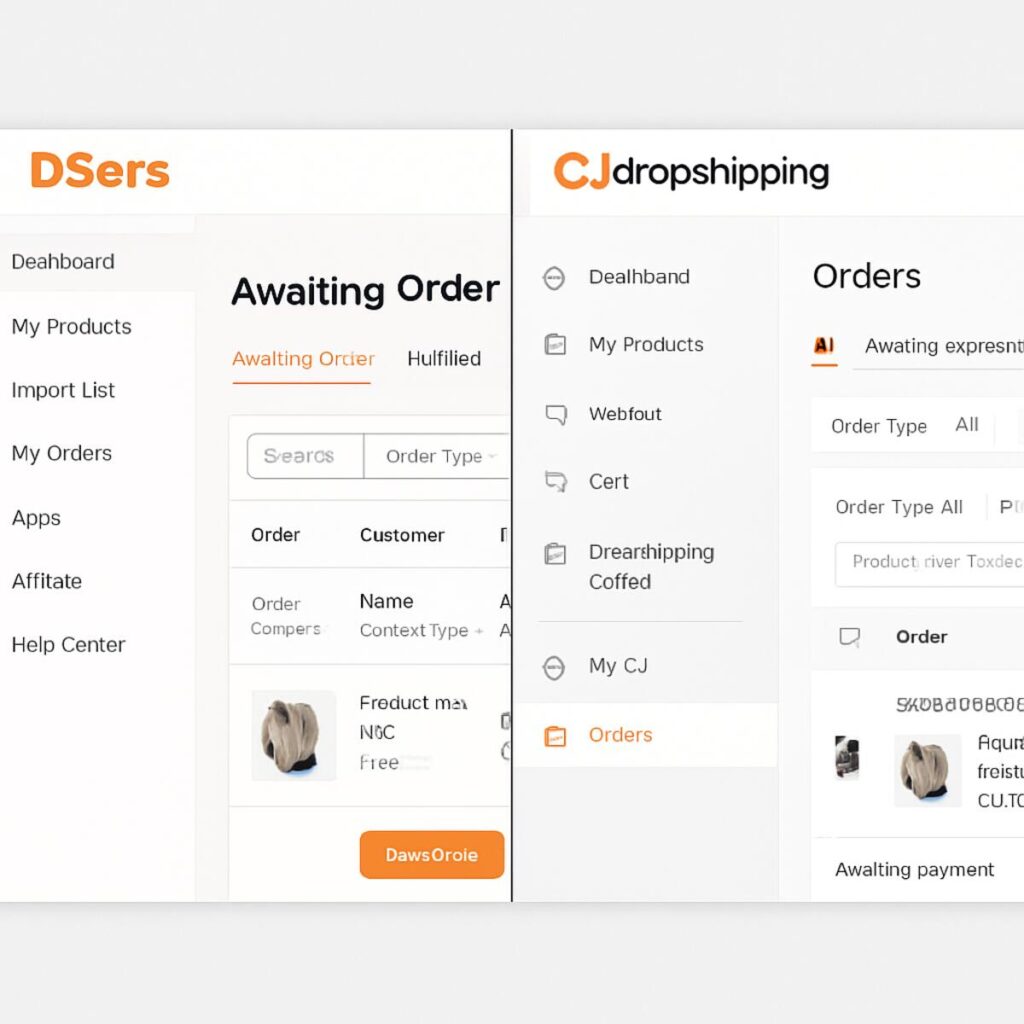
DSers vs CJ Dropshipping Review: Which is Better?
As you scale, you might start questioning whether AliExpress is the best long-term partner. This is where CJ Dropshipping enters the conversation. A common debate among merchants requires a thorough DSers vs CJ Dropshipping review to determine the right path forward.
DSers is essentially an aggregator and automation tool for AliExpress. You are still dealing with individual Chinese vendors, which means shipping times, product quality, and communication can vary wildly from order to order.
CJ Dropshipping, on the other hand, is a comprehensive supplier and fulfillment service. They source products themselves, store them in their own warehouses (including overseas warehouses in the US and Europe), and ship them to your customers.
- Product Sourcing: With CJ Dropshipping, if you find a product on AliExpress that isn’t in CJ’s catalog, you can request that they source it for you. They will typically find it, offer a competitive price, and handle the fulfillment.
- Quality Control: Because CJ physically handles the products, their quality control is generally more consistent than rolling the dice with random AliExpress sellers via DSers.
- Custom Packaging: CJ allows you to add custom flyers, thank-you cards, and branded packaging, which is a massive step toward building a real brand.
The Verdict: Use DSers when you are just starting and testing dozens of cheap products. Transition to CJ Dropshipping when you have a winning product and need more reliable fulfillment, faster shipping, and custom branding.
Finding Reliable US-Based Dropshipping Partners
One of the biggest hurdles in traditional dropshipping is long shipping times. Modern consumers are conditioned by Amazon Prime to expect their orders in two to three days. If you are making them wait three weeks for a package from China, you will inevitably face chargebacks and angry customer service emails.
Finding reliable US-based dropshipping partners is the ultimate solution to this problem. By working with suppliers located in the same country as your target audience, you can drastically reduce transit times.
Spocket: The King of Local Sourcing
When people ask which dropshipping app has the fastest shipping, Spocket is frequently the answer. Spocket was built specifically to solve the slow-shipping crisis. Approximately 80% of Spocket’s suppliers are based in the US or Europe.
Why Spocket Stands Out:
- Vetted Suppliers: Spocket heavily vets their suppliers. They do not let just anyone onto the platform, ensuring high product quality and reliable shipping speeds.
- Branded Invoicing: You can add your store’s logo and personalized notes to the invoices included in the packages, preventing customers from feeling like they bought from a third party.
- Fast Shipping: Because products are stored locally, shipping times are often reduced to 2-5 days, rivaling traditional e-commerce brands.
Zendrop: Built by Dropshippers, for Dropshippers
Another excellent platform for local sourcing is Zendrop. Originally created to fix the communication and shipping issues plaguing AliExpress dropshippers, Zendrop offers access to over a million products with expedited shipping options.
Zendrop connects directly with reliable manufacturers and provides transparent shipping times. They offer a US fulfillment option, custom branding, and automated fulfillment, making them one of the best dropshipping suppliers for beginners who want to avoid the pitfalls of overseas sourcing.
Specialized Sourcing: High-Ticket, White-Label, and POD
Not all dropshipping models rely on selling low-cost gadgets or apparel. Depending on your business model, you might need highly specialized Shopify dropshipping apps to source unique products.
High-Ticket Dropshipping Product Sourcing
Instead of selling hundreds of $20 items, high-ticket dropshipping focuses on selling fewer items at $500, $1,000, or even $5,000 each. The profit margins are significantly higher, and you generally deal with fewer customer service inquiries. However, finding reliable suppliers for luxury goods, heavy furniture, or commercial equipment requires different tools.
Apps like AppScenic and BrandsGateway are built for this.
- BrandsGateway specializes in luxury fashion. If you want to dropship authentic Gucci, Dolce & Gabbana, or Michael Kors, this app integrates seamlessly with Shopify, providing high-quality images and real-time inventory updates.
- AppScenic gives you access to a massive catalog of high-ticket and premium products across various categories, all shipped from top-tier countries like the USA, UK, and Canada.
White-Label Product Sourcing
If you want to sell products with your own brand name on them without holding inventory, you need white-label product sourcing. This is particularly popular in the cosmetics, supplements, and coffee niches.
Supliful is a fantastic Shopify app for dropshipping FDA-compliant supplements and packaged foods. You simply choose a base product (like whey protein, gummies, or skincare creams), design a label using their templates, and publish the product to your store. When a customer orders, Supliful prints your label, applies it to the product, and ships it directly to the customer. This allows you to build a highly profitable, branded CPG (Consumer Packaged Goods) company with zero upfront inventory costs.
Print-on-Demand Services for Ecommerce
Print-on-demand (POD) is a specific type of dropshipping where you apply your custom designs to blank products—like t-shirts, mugs, canvas prints, or phone cases. The product is only manufactured when a customer makes a purchase.
The two heavyweights in print-on-demand services for ecommerce are Printful and Printify.
- Printful owns its printing facilities. This means they have incredible quality control and consistency, though their base product costs are slightly higher. They integrate flawlessly with Shopify and offer high-end techniques like embroidery and all-over printing.
- Printify operates as a network. They connect your store to various independent print providers around the world. Because providers compete on the platform, you can often find lower base costs, but you have to manage different vendors and potential variations in print quality.
Automating Your Dropshipping Empire
The true beauty of a dropshipping business is that it can run 24/7. However, if you are manually handling pricing, ordering, and inventory, you have simply created a low-paying job for yourself. True scalability comes from automation.
How to Automate Shopify Order Processing
In the early days of your store, receiving an order notification is thrilling. You log in, take the customer’s details, go to your supplier’s website, and place the order. But what happens when you scale to 50 or 100 orders a day? Manual processing becomes impossible.
Understanding how to automate Shopify order processing is critical. Most premium sourcing apps (like DSers, CJ Dropshipping, and Spocket) feature an “Auto-Fulfill” setting.
Here is how you set up automated order fulfillment for Shopify:
- Link your accounts: Ensure your sourcing app is properly integrated with your Shopify store via API.
- Add a payment method to the app: You need to have a credit card or a wallet balance on file with your supplier app.
- Enable Auto-Fulfillment: Toggle the setting in your app that allows the supplier to automatically process an order the moment it is paid for on your Shopify store.
- Set fulfillment delays (Optional but recommended): It is wise to set a 12-to-24-hour delay before an order is automatically sent to the supplier. This gives customers a window to cancel their order or change their shipping address, saving you massive headaches.
Once set up, a customer buys a product, your supplier charges your card on file for the wholesale cost, and the supplier ships the item. You keep the difference, and the entire process happens while you sleep.
Automated Price Markup Rules
When dealing with hundreds of products, updating prices manually is a recipe for disaster. Supplier costs fluctuate constantly due to shipping rates, material costs, and currency exchange rates. If a supplier raises their price by $3 and you don’t notice, your profit margin could be completely wiped out.
To protect your margins, you must implement automated price markup rules. Most robust dropshipping apps allow you to set global pricing rules based on the supplier’s cost.
Best practices for automated pricing:
- Fixed Multiplier: Set your store to automatically multiply the supplier’s cost by a specific number (e.g., 2.5x or 3x). If a supplier charges $10, your store automatically prices it at $25 or $30.
- Advanced Cent Rules: Psychological pricing matters. You can set rules so that no matter what the multiplier calculates, the final price always ends in “.99” or “.95” (e.g., automatically adjusting a $24.43 calculation to $24.99).
- Compared-at Pricing: Automate your “sale” prices. You can set a rule that automatically generates a “Compare at” price that is 30% higher than your actual selling price, giving the illusion of a permanent discount to increase conversion rates.
Mastering Inventory and Multi-Supplier Operations
One of the most dangerous scenarios in dropshipping is selling a product you don’t actually have. Because you do not control the warehouse, a supplier could run out of stock without warning. If you sell that out-of-stock item to a customer, you are forced to issue a refund, pay transaction fees, and deal with a frustrated buyer.
Real-Time Inventory Tracking
To prevent selling out-of-stock items, your Shopify dropshipping apps must feature real-time inventory tracking. This feature constantly pings the supplier’s database. If the supplier’s stock drops to zero, the app automatically updates your Shopify product listing to “Out of Stock,” preventing customers from making a purchase.
When evaluating a new supplier app, real-time inventory syncing is a non-negotiable feature. Apps like Syncee, Spocket, and DSers handle this beautifully, updating inventory levels daily or even hourly.
Syncing Inventory Across Multiple Suppliers
As your store grows, relying on a single supplier becomes a massive risk. If their factory shuts down or they discontinue your winning product, your revenue stops instantly. The solution is to have backup suppliers.
However, syncing inventory across multiple suppliers requires sophisticated e-commerce solutions. Let’s say you sell a specific coffee grinder. You might have Supplier A (in the US) and Supplier B (in China).
You can use advanced inventory management apps (like Stocky or dedicated features within Zendrop and CJ Dropshipping) to map multiple suppliers to a single Shopify product variant.
- You can set routing rules: “If Supplier A has stock, fulfill via Supplier A. If Supplier A is out of stock, automatically route the order to Supplier B.”
- This creates a resilient supply chain, ensuring that even if one supplier fails, your business keeps generating revenue seamlessly.
Shipping, Delivery, and the Dreaded Returns
Marketing gets the sale, but logistics keep the business alive. If your post-purchase experience is terrible, your ad accounts will eventually be banned due to poor customer feedback scores, and payment processors will freeze your funds.
Which Dropshipping App Has the Fastest Shipping?
We touched on this briefly, but it deserves deeper analysis. Fast shipping is a marketing tool. Being able to proudly display “3-5 Day US Shipping” on your product page will skyrocket your conversion rates.
If you are strictly evaluating based on shipping speed:
- Spocket: Consistently wins for domestic US and EU shipping, often delivering in 2-5 days.
- Supliful: Because they are based in the US and produce on-demand supplements, their domestic shipping is incredibly fast.
- Zendrop: Their US-warehouse feature provides excellent delivery times for stateside customers.
- CJ Dropshipping (US Warehouses): If you utilize CJ’s local warehouses rather than shipping from China, you can achieve 3-7 day shipping times at highly competitive rates.
Managing Returns with Dropshipping Suppliers
Returns are the Achilles’ heel of the dropshipping model. When a customer wants to return an item, where do they send it? Most Chinese suppliers will not accept returns, or if they do, the return shipping cost is higher than the product’s value.
Managing returns with dropshipping suppliers requires a clear strategy and the right apps.
Step 1: Have a bulletproof return policy. Be incredibly transparent on your website. Only offer returns for defective, damaged, or severely delayed items. For “buyer’s remorse,” state clearly that all sales are final, or that the buyer is responsible for return shipping to your physical location.
Step 2: Utilize Return Management Apps. Apps like Returnly or AfterShip Returns Center are vital. They automate the return process for the customer, allowing them to print a shipping label and track their return without emailing you.
Step 3: Work with supplier apps that offer refunds without returns. Top-tier apps like Spocket and Zendrop have excellent dispute policies. If a product arrives broken, you simply upload a photo from the customer into the app, and the supplier will issue a refund or a free replacement without requiring the customer to mail the broken item back. This allows you to immediately refund or replace the item for your customer, turning a negative experience into a positive one.
If you are using AliExpress/DSers, it is often cheaper to simply refund the customer out of pocket and let them keep the item, rather than dealing with the logistical nightmare of international return shipping. Factor a 3-5% return rate into your automated price markup rules to cover these eventualities.
Beyond Sourcing: Essential Support Apps for Dropshipping Success
While sourcing and fulfillment are the core of your business, relying solely on dropshipping supplier apps won’t build a sustainable brand. You need auxiliary shopify apps to boost trust, increase average order value, and handle customer relations.
1. Building Trust with Reviews (Loox or AliReviews)
When you import products, you start with zero reviews. Consumers rarely buy products with zero social proof. Apps like Loox or AliReviews allow you to import photo reviews directly from your supplier (like AliExpress) to your Shopify store. This instantly builds credibility and increases conversion rates.
2. Email Marketing and Abandoned Cart Recovery (Klaviyo)
A vast majority of people will add your dropshipped product to their cart and leave. Klaviyo is the industry standard for Shopify email marketing. You can set up automated email flows that trigger when someone abandons checkout, offering them a 10% discount to complete their purchase. This single automation can recover 10-15% of your lost sales automatically.
3. Customer Service Helpdesks (Gorgias or Reamaze)
When shipping times are slightly longer, customer inquiries increase. “Where is my order?” will be the most common email you receive. Gorgias is a helpdesk app designed specifically for Shopify. It pulls all customer data into the dashboard. When a customer emails you, Gorgias shows their tracking number, order status, and shipping address right next to the ticket. You can even set up macros (automated templates) to reply to “Where is my order?” emails in one click, drastically reducing the time spent on customer support.
4. Upselling and Cross-Selling (ReConvert or Frequently Bought Together)
Because dropshipping margins can be thin after ad spend, you must increase your Average Order Value (AOV). Apps like Frequently Bought Together mimic Amazon’s algorithm, showing related products on the product page. If you are dropshipping a flashlight, the app will automatically suggest batteries or a carrying case. ReConvert allows you to put upsells on the “Thank You” page, capturing extra revenue after the customer has already completed their initial checkout.
Actionable Takeaways: Building Your Tech Stack
We have covered a massive amount of ground. To make this actionable, here is how you should structure your Shopify apps depending on where you are in your journey.
The Beginner Stack (Focus: Low Cost, Broad Testing)
- Sourcing: DSers (for importing from AliExpress to Shopify quickly and cheaply).
- Reviews: AliReviews.
- Email: Shopify Email (Free) or a basic Klaviyo plan.
- Strategy: Test multiple products. Find a winner without spending thousands on inventory. This stack leverages the best dropshipping suppliers for beginners to keep risks incredibly low.
The Scaling Stack (Focus: Faster Shipping, Automation, Branding)
- Sourcing: CJ Dropshipping or Zendrop (for better shipping times and custom packaging).
- Pricing: Implement automated price markup rules to protect margins dynamically.
- Support: Gorgias (to handle the influx of customer inquiries).
- Strategy: Focus on automated order fulfillment for Shopify. Transition away from AliExpress to ensure your winning product is delivered reliably and quickly.
The Brand Builder Stack (Focus: White Label, US Sourcing, High Margins)
- Sourcing: Spocket, Supliful, or Printful.
- Inventory: Advanced apps for syncing inventory across multiple suppliers.
- Marketing: Loox (for photo reviews), ReConvert (for AOV optimization).
- Strategy: Build a real, sellable asset. Utilize white-label product sourcing or find reliable US-based dropshipping partners to provide an Amazon-level customer experience.
Conclusion
The e-commerce landscape is highly competitive, but it is also more accommodating than ever before. You no longer need thousands of dollars in capital or an entire warehouse to build a global retail business.
By strategically selecting the right Shopify dropshipping apps, you essentially hire an army of digital employees. Tools like DSers and CJ Dropshipping act as your global sourcing agents. Apps like Spocket and Printful serve as your local logistics managers. Automated pricing rules become your financial analysts, and real-time inventory tracking acts as your warehouse foreman.
Remember, e-commerce solutions are only as good as the strategy behind them. Don’t fall into the trap of installing forty different apps, slowing down your website, and complicating your workflow. Start with the essentials: a reliable sourcing app with real-time inventory updates, a robust automated fulfillment process, and tools to handle your customer service and returns gracefully.
As you transition from a beginner looking for winning products to an advanced merchant exploring high-ticket dropshipping product sourcing and white-labeling, let your software scale with you. Embrace the automation, prioritize the customer experience, and let these powerful apps do the heavy lifting while you focus on what really matters: marketing your brand and growing your business.